Services / Software & data systems

Connect the systems.
Clarify the operation.

Service areas for the data and software challenges of battery engineering. Each engagement is shaped around its sources, users and intended outcomes.

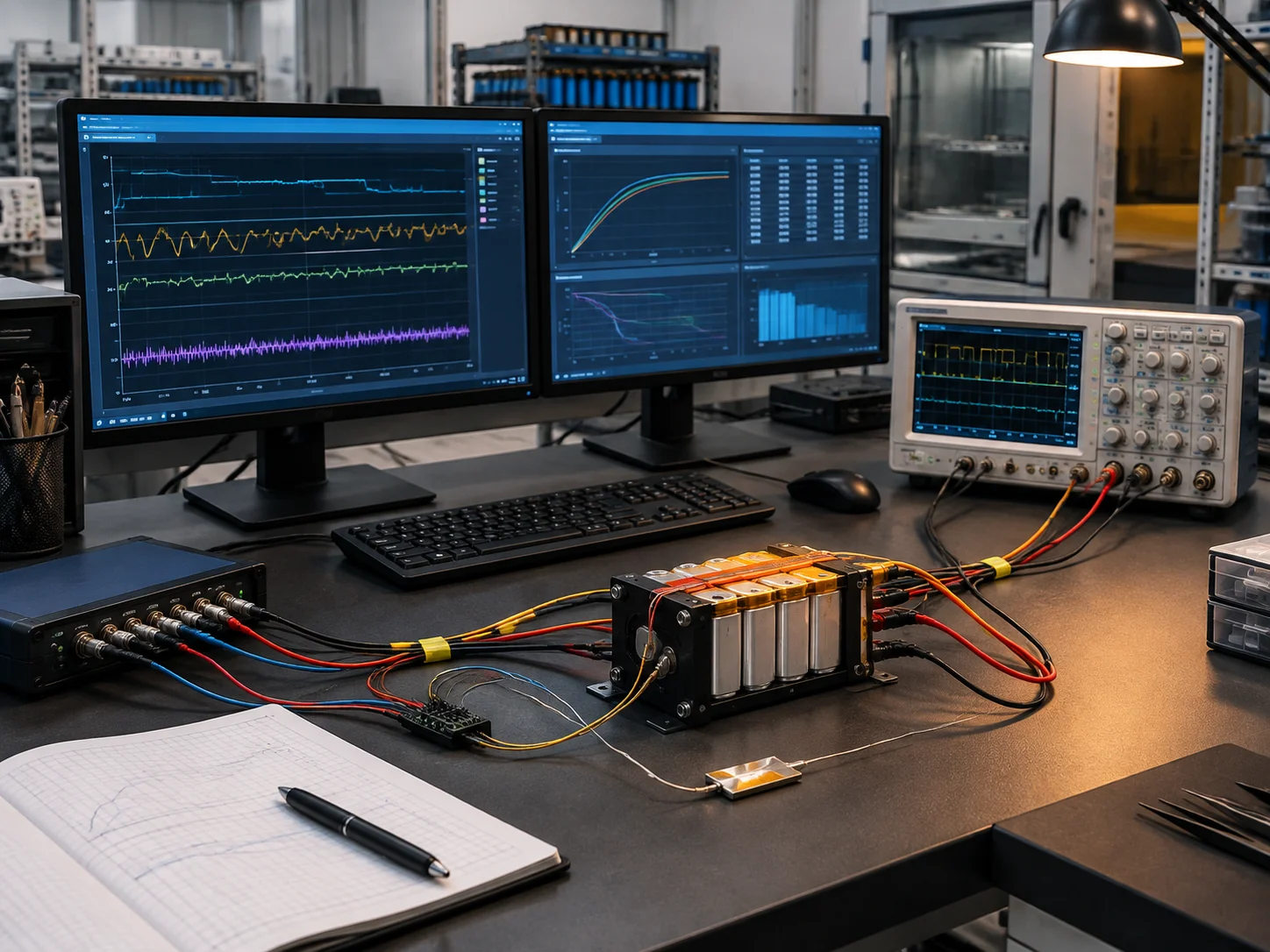
Illustrative engineering workstation with measurement traces, test instruments and a wired battery module
Fig. 01 / Instrumentation and operational software. Illustrative workstation.
01 / Service areas
01

Software development

Purpose-built applications for battery operations, from engineering workflows to the software that connects people, equipment and data.

Typical outputs
Application architecture, workflow interfaces, documented software components.

02

Telemetry data pipelines

Structured paths from device measurements to usable datasets, with context preserved across capture, processing and storage.

Typical outputs
Ingestion adapters, validation rules, normalized schemas and processing pipelines.

03

Systems integration

Connections between test equipment, existing applications and data platforms, with explicit interfaces and consistent identifiers.

Typical outputs
API integrations, interface specifications, data mappings and exchange routines.

04

Operational dashboards

Focused views of test activity, measurement trends and data exceptions that help teams understand operational context.

Typical outputs
Dashboard views, trend visualizations, exception views and contextual drill-downs.

05

Reporting

Repeatable reporting workflows that bring measurements, test context and engineering observations into a coherent record.

Typical outputs
Report templates, export routines, scheduled processing and traceable datasets.

02 / Illustrative workflow

From test-bench exports to a reviewable dataset.

Example only: a team wants a consistent way to inspect voltage and temperature trends across test runs. This is an illustrative workflow, not a delivered project or product claim.

01 / →

Capture

Collect voltage, current and temperature measurements alongside device and test identifiers.

02 / →

Contextualize

Align timestamps, units and metadata so each reading retains its engineering meaning.

03 / →

Validate

Identify missing values, duplicates and unexpected ranges before downstream use.

04 / Output

Make visible

Present structured data through operational views and repeatable reports.

Typical supporting outputs could include a source-to-schema mapping, validation rules, a trend view and an export with test identifiers. The actual deliverables depend on the agreed project scope.

03 / Defining the scope

A clear boundary.
A useful outcome.

Relevant inputs include the available equipment interfaces, sample datasets, existing applications and the decisions the software is intended to support.

Requirements, access constraints, validation criteria and operating responsibilities can then be agreed before implementation. No delivery schedule, performance result or product availability is implied here.

Start a conversation

Bring your systems into focus.

For inquiries about battery telemetry, software development, systems integration and operational reporting.